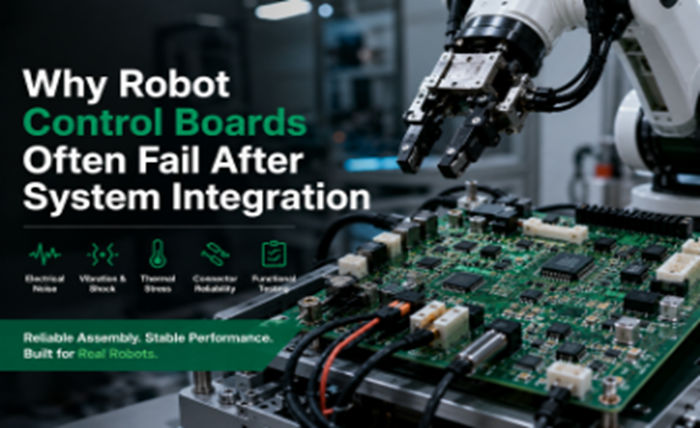
A control board may pass bench testing and still develop problems once it is installed inside a robot. That is because real robotic systems introduce vibration, motor noise, power fluctuations, thermal stress, and repeated connector movement. Reliable robot control board assembly and well-planned PCBA services therefore need to consider how the board will behave inside the complete machine, not just whether it works immediately after assembly.
Bench Testing Does Not Reproduce the Real Robot
During early development, engineers often test the PCB under relatively stable conditions.
Once the board is installed in a robot, however, it may experience:
- Rapid motor switching
- Mechanical vibration
- Repeated power cycling
- Sensor and communication interference
- Limited airflow inside the enclosure
These conditions can reveal weaknesses that were not obvious during initial testing.
Motor Systems Can Create Electrical Stress
Motors, relays, and high-current drivers can introduce electrical noise into the system.
If connectors, solder joints, or power components are not assembled consistently, these stresses may contribute to intermittent faults or unstable operation.
For this reason, manufacturing quality becomes especially important around:
- Motor driver sections
- Power connectors
- High-current terminals
- Ground connections
Mechanical Integration Changes the Risk
Robot control boards are rarely used as standalone PCBs.
They may be mounted close to motors, gearboxes, batteries, or moving structures. Cable tension and repeated movement can also place stress on connectors and through-hole components.
A reliable assembly process should therefore pay attention to mechanically sensitive areas rather than treating every solder joint in the same way.
Functional Testing Should Match Real Connections
Testing becomes more useful when it reflects the actual interfaces used in the robot.
Depending on the design, PCBA services may include verification of:
- Communication ports
- Sensor inputs
- Motor control outputs
- Power rails
- Programming functions
This provides a better indication of how the board will behave after installation.
Design Revisions Are Normal in Robotics
Robotics development is highly iterative. Changes to motors, sensors, mechanical structures, or firmware can also require PCB revisions.
A manufacturer that can support repeated prototype builds and small production batches helps engineering teams respond to these changes without restarting the manufacturing process each time.
Conclusion
The real challenge in robot control board assembly is not simply producing a board that powers on. It is producing one that continues to operate reliably after it becomes part of a moving, electrically noisy, and mechanically demanding robotic system. Manufacturing processes and PCBA services that account for these real operating conditions can reduce integration problems and improve long-term system stability.