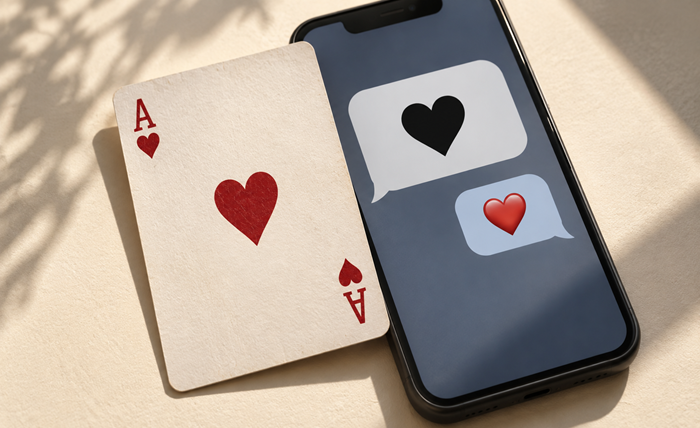
A heart on a playing card, a heart typed into a message, and a heart drawn on a slot reel can share an outline without being the same kind of object. The card uses it to identify a suit. The message contains a text character. The reel carries artwork whose role belongs to that particular game. Moving between them can change the appearance, the meaning, or both.
Even ordinary emoji do not have one fixed drawing. Emojipedia’s January 2026 review of emoji design changes documents how different vendors have revised their artwork, sometimes bringing designs closer together and sometimes moving them apart. A recognizable symbol can therefore survive a move between apps while its colour, proportions, or details change.
What copying actually carries
When you copy plain text, you transfer characters, rather than a photograph of the letters and symbols on your screen. The receiving app chooses how those characters appear, using its fonts or emoji artwork. A font supplies visible character shapes, known as glyphs. Keeping the same character does not require keeping the same glyph.
Casino symbols make that distinction particularly clear. A heart suit remains a heart suit whether the card design uses a narrow shape or a rounded one. A diamond drawn as a gemstone on a reel, however, needs its own description. Its resemblance to the diamond suit does not make the two interchangeable.
When you’re looking at games on Sportaza online casino, card descriptions need ranks and suits, while reel symbols need wording from the relevant game’s instructions. Replacing a distinctive illustration with a familiar emoji can lose the detail that identifies it. Keep any written symbol label with the description, especially when several pieces of artwork share a colour or shape.
Copying a picture and copying a text symbol preserve different information. A picture carries the captured design, while plain text leaves its appearance to the receiving software. An image of casino artwork keeps details that a substitute keyboard character would leave out.
One heart, two presentation requests
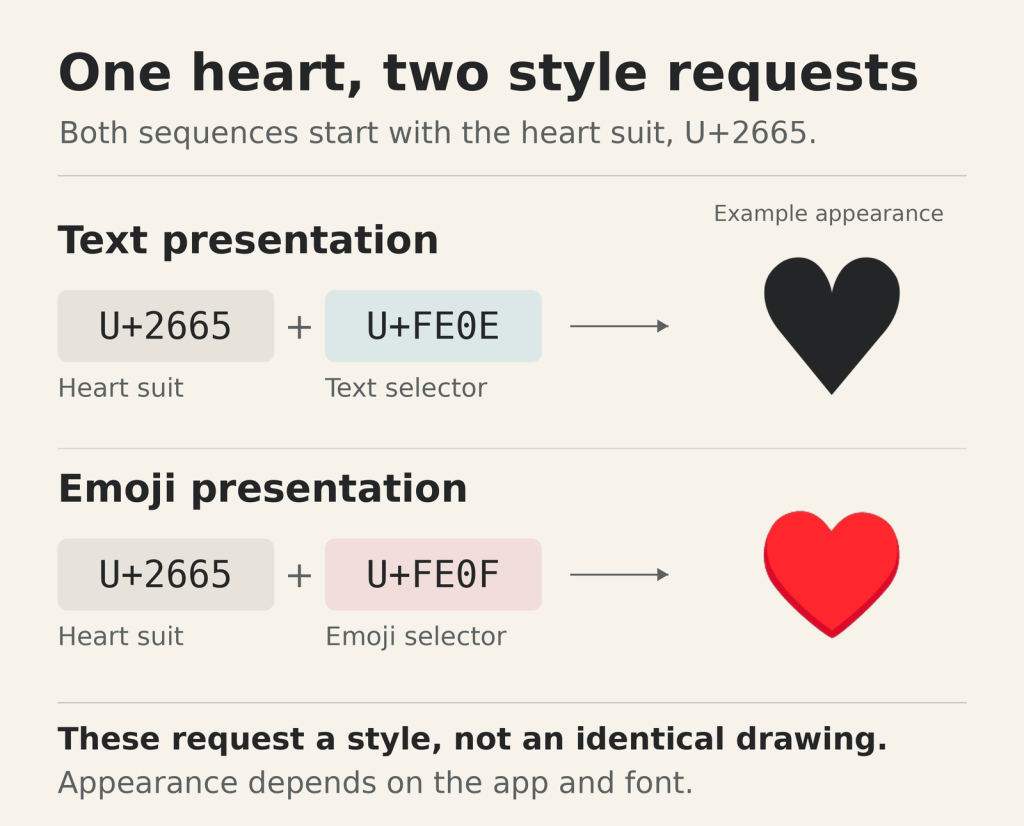
Unicode provides a precise example using the heart-suit character identified as U+2665. The code is a written identifier for the character, not something readers need to type into an ordinary message.
Two documented sequences pair that heart with an additional, normally invisible character called a variation selector:
- U+2665 followed by U+FE0E requests text presentation: ♥︎.
- U+2665 followed by U+FE0F requests emoji presentation: ♥️.
The first requests the text style, typically a simple symbol that fits alongside lettering. The second requests the emoji style, which may use colour and a more pictorial design. Both sequences begin with the same heart-suit character. The extra character tells the software how to present it.
These are requests, not promises of a particular drawing. Unicode explicitly allows variation in presentation, and support depends on the software displaying the text. The two hearts may look different in one app and similar in another. Copying either sequence cannot guarantee the appearance of a specific card or reel graphic.
There is also a useful limit to this technique: variation selectors work with defined character sequences. Adding one to an arbitrary letter or decorative shape does not turn it into custom casino artwork. They select a presentation style where supported; they do not import an illustration.
Character names can add another source of confusion. U+2665 is formally named BLACK HEART SUIT, but that does not require software to draw it in black. In this naming convention, black generally distinguishes a filled shape from an outlined one. The outlined heart suit has a separate identity, U+2661, named WHITE HEART SUIT. Choosing that outlined character changes the character itself; requesting text presentation for U+2665 leaves the base character intact. Neither choice specifies the exact shade of red used on a particular playing card.
A reel symbol needs its own description
Reel artwork adds a separate question: what does this particular image represent inside the game? A symbol’s resemblance to a fruit, jewel, or familiar shape describes its appearance, but does not establish its role.
For a written reference, start with the game title and the symbol’s own name or label. Include the relevant explanation when the purpose is to describe what the symbol does. That keeps the wording tied to the correct game, rather than asking the reader to infer a function from an emoji.
Colour alone is a weak identifier. Two symbols can share a colour, and an emoji’s appearance can change between devices. A short description of the actual artwork is more useful than choosing whichever keyboard symbol looks closest. Where the exact visual detail is the subject, an image preserves information that plain text cannot.
Choose what the message needs to preserve
The Unicode Consortium explains that each encoded character has a numeric identity. That shared identity lets software recognize text across systems, while fonts and emoji designs determine its visible form. A custom game illustration does not automatically become a copyable character because its outline looks familiar.
Use a suit character when the suit is the information. Use a symbol’s name and its game context when the meaning is the information. Use an image when the drawing itself needs to be shown. Those choices preserve different things, so the closest-looking emoji is not always the most accurate way to describe what appeared on screen.