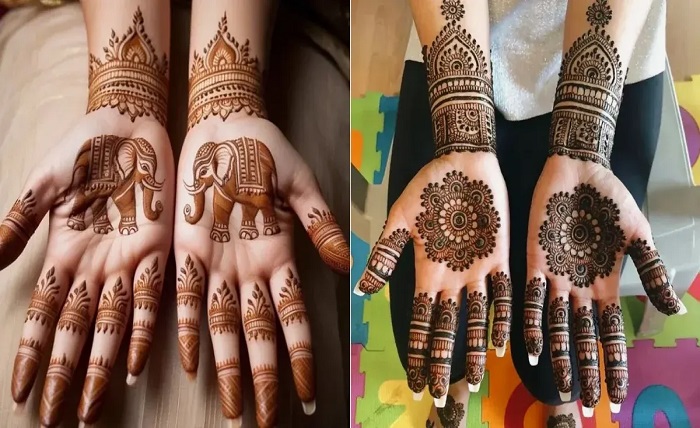
When it comes to traditional body art, few things exude elegance like a royal front hand mehndi design. This style focuses on the back of the hand (the front, as seen when palms face down), often extending to the fingers and wrist. Unlike the dense palm, the front hand offers a canvas for symmetrical, intricate motifs that catch immediate attention during greetings, prayers, or dining. A royal front hand mehndi design incorporates regal elements—jewels, tassels, arches, and lattice work—that mimic palace artistry. Modern brides and festive-goers prefer this placement because it stays visible longer than palm mehndi, which fades faster due to friction. Whether you choose a minimal look or a full-coverage pattern, a royal front hand mehndi design instantly elevates your style. The keyword “royal” implies a fusion of Mughal, Rajput, and Persian influences, making your hand a storytelling canvas. In short, no other mehndi style balances visibility and sophistication like a royal front hand mehndi design.
Key Elements That Define a Royal Front Hand Mehndi Design
To truly master a royal front hand mehndi design, you must understand its core components. First, the central motif—often a large lotus, a diamond-shaped palace arch, or a peacock—dominates the back of the hand. Second, border patterns such as delicate dots, dashes, or chain links frame the fingers and wrist. Third, fillers like crushed leaves, Moroccan triangles, or tiny circles ensure no empty space remains, a hallmark of royal aesthetics. A royal front hand mehndi design also uses negative space sparingly; instead, it layers motifs from the knuckles down to the lower forearm. Fourth, finger patterns—often individual lacy trails or full coverage—enhance the regal feel. Fifth, the wrist area features cuffs or bracelets that mimic jewelry. Without these five elements, a royal front hand mehndi design risks looking ordinary. Remember, symmetry is crucial: a royal design is almost always mirrored on both hands if done for weddings. Even a single-hand royal front hand mehndi design should feel balanced, with equal weight distributed across the metacarpal area.
Step-by-Step Process to Create a Royal Front Hand Mehndi Design
Creating a royal front hand mehndi design requires patience and the right tools. Start with clean, exfoliated hands—no oils or lotions. Use a fresh mehndi cone with a fine tip (0.5–1 mm). First, outline a central arch on the back of the hand, about an inch below the knuckles. Inside this arch, draw a large flower or a paisley; this becomes the anchor of your royal front hand mehndi design. Next, add two side panels—one pointing toward the thumb, another toward the pinky. Fill each panel with vertical lines, dots, or tiny leaf vines. Then, work on the wrist: create a thick bracelet pattern with alternating diamonds and triangles. For the fingers, each finger should get a unique but cohesive trail—e.g., index finger gets a full vine, middle finger gets a half-moon chain. The thumb often features a standalone royal front hand mehndi design element like a miniature dome. Allow the paste to dry for 2–4 hours, then scrape off gently. The stain will deepen from orange to maroon over 24 hours. Pro tip: apply lemon-sugar mixture twice to ensure a dark, long-lasting royal front hand mehndi design.
Top 5 Variations of Royal Front Hand Mehndi Design for Every Occasion
Not all royal styles are identical. Here are five distinct takes on a royal front hand mehndi design:
1. The Bridal Royal Front Hand Mehndi Design – Extremely dense, with hidden couple initials, elephant motifs, and full finger coverage. Often paired with a matching palm design.
2. The Minimalist Royal Front Hand Mehndi Design – Uses thin lines and large negative spaces. Just one central jewel motif on the hand and single-stroke finger patterns. Perfect for office parties or Ramadan evenings.
3. The Arabic-Royal Fusion – Bold, flowing vines combined with royal geometric shapes. This royal front hand mehndi design leaves the fingertips bare but covers knuckles with independent flowers.
4. The Monochromatic Royal Front Hand Mehndi Design – Uses only black jagua or high-cone henna for a stark, tattoo-like effect. Very popular among Gen Z bridesmaids.
5. The Vintage Royal Front Hand Mehndi Design – Features faded edges, crushed henna texture, and old-world motifs like vintage cars, old coins, or cameo portraits. A storytelling royal front hand mehndi design.
Each variation serves a different event length and skin tone preference. Choose your royal front hand mehndi design based on how long you want the stain to last (dense = longer) and how much attention you want to draw to your hands.
Mistakes to Avoid When Applying a Royal Front Hand Mehndi Design
Even experienced artists can ruin a royal front hand mehndi design with a few common errors. Mistake #1: Skipping the patch test. Some henna brands cause allergic reactions; test on your inner elbow 24 hours before committing to a full royal front hand mehndi design. Mistake #2: Making lines too thick. Royal patterns rely on hairline strokes; a thick cone will bleed, turning your regal pattern into a blob. Mistake #3: Ignoring the web of the thumb. That webbed area is highly visible when you wave or hold a phone; include a small diamond or dot there in your royal front hand mehndi design. Mistake #4: Overcrowding. A royal look is rich but still readable; leave tiny breathing spaces (called “chasm”) between major motifs. Mistake #5: Wetting the design too soon. If you wash your hands within 6 hours of applying a royal front hand mehndi design, the stain will be pale orange. Mistake #6: Using old, frozen henna. Fresh henna (less than 2 weeks old) gives the deepest burgundy for your royal front hand mehndi design. Always check the expiry.
How to Make Your Royal Front Hand Mehndi Design Last Longer
You’ve invested hours in a stunning royal front hand mehndi design; now protect it. Immediately after scraping off the dried paste, avoid water for 12 hours. Apply a mix of eucalyptus oil and clove oil using a cotton ball; this heat helps the stain mature. For the first 48 hours, wear loose cotton gloves while sleeping—tight fabrics can crack your royal front hand mehndi design prematurely. When bathing, use a waterproof glove or smear a layer of Vaseline over the mehndi before showering. Do not exfoliate or use chlorine (pools, detergents). Another secret: avoid using hand sanitizers or alcohol-based wipes; they strip the top layer of skin where your royal front hand mehndi design sits. If you need to wash dishes, wear rubber gloves. To deepen the color, apply a warm compress (a heated towel) twice a day for three days after application. With proper care, your royal front hand mehndi design can last 3–4 weeks on the back of the hand, though fingers may fade faster. Remember: the palm side of the front hand (the actual palm) does not hold a royal design well because of sweat and movement; keep the royal front hand mehndi design strictly dorsal for longevity.
Inspirational Occasions to Flaunt a Royal Front Hand Mehndi Design
A royal front hand mehndi design is not just for weddings. Eid celebrations, Diwali parties, engagement ceremonies, and even baby showers welcome such artistry. For bridesmaids, a slightly less dense royal front hand mehndi design complements the bride’s full coverage. Grooms also are increasingly requesting a royal front hand mehndi design on one hand for sangeet or mehendi nights—often just a bold peacock or a lion motif on the front hand, leaving fingers bare. Dance performances (Bharatanatyam, Kathak) look mesmerizing when dancers sport a royal front hand mehndi design, as hand gestures (mudras) highlight every line. Even maternity photoshoots use a temporary royal front hand mehndi design to draw the eye toward a baby bump. Corporate festivals? A tiny, subtle royal front hand mehndi design on the thumb web and index finger can be a conversation starter. Ultimately, any event where you shake hands, hold a cup of chai, or wave to a camera is the perfect stage for a royal front hand mehndi design. Don’t wait for a “big day”—practice these designs on weekends to perfect your art.
Conclusion
A royal front hand mehndi design is more than a trend—it’s a timeless expression of culture, patience, and beauty. From understanding its core elements (arches, lattice, finger trails) to avoiding common mistakes like thick lines or premature washing, every step matters. We’ve explored five unique variations—bridal, minimal, Arabic-fusion, monochromatic, and vintage—so you can match a royal front hand mehndi design to any occasion, be it a wedding or a casual festive dinner. Longevity tricks like eucalyptus oil and cotton gloves ensure your royal front hand mehndi design stays rich for weeks. Remember, the back of the hand is your prime canvas: symmetrical, visible, and regal. Whether you’re a beginner practicing with a practice sheet or a professional artist taking commissions, keep refining your royal front hand mehndi design skills. The demand for such intricate, palace-inspired artwork is only growing, especially with social media reels showcasing transformation videos. So go ahead—pick up that cone, trace your central arch, and let your hands wear a crown. A well-executed royal front hand mehndi design doesn’t just decorate; it announces elegance without a single word.
FAQs
1: Can I do a royal front hand mehndi design on myself using my non-dominant hand?
Yes, but it requires practice. Use a stencil or a transfer paper first. Many artists start with a royal front hand mehndi design on their dominant hand by slowing down and working in short segments. Alternatively, buy a pre-made sticker mehndi that mimics a royal front hand mehndi design for perfect symmetry.
2: How long does it take to complete a royal front hand mehndi design?
A moderately dense royal front hand mehndi design takes 30–45 minutes for one hand. A full bridal-level design with both front hands and fingers can take 2–3 hours. Always factor in drying time (2–4 hours) before scraping.
3: Is a royal front hand mehndi design suitable for dark skin tones?
Absolutely. In fact, a royal front hand mehndi design shows up beautifully on darker skin because the stain turns a deep burgundy-brown, creating a warm contrast. Avoid black henna (which contains PPD) and stick to natural henna for a safe royal front hand mehndi design.
4: Can I apply a royal front hand mehndi design over eczema or cuts?
No. Never apply mehndi on broken skin or active eczema. The essential oils (eucalyptus, clove) in many cones can irritate. Wait for complete healing before attempting any royal front hand mehndi design on affected areas.
5: What’s the price range for a professional royal front hand mehndi design?
Prices vary by location and artist skill. In South Asia, a good royal front hand mehndi design costs 5–15 per hand. In Western countries, expect 30–80. Bridal packages that include both front hands, palms, and feet go up to 200–500. Always ask for a portfolio of previous royal front hand mehndi design work before booking.