The GPT-5.6 Luna API is OpenAI’s economy-tier reasoning model — released July 9, 2026 per Artificial Analysis, with a 1M-token context window — and the key that reaches it is the first real integration decision, because the same credential can also unlock the rest of the family. A key issued on OpenAI’s own platform talks only to OpenAI; a key issued through a router speaks the same dialect and puts the same models behind one credential alongside 200-plus others at list price, and GPT-5.6 Luna carries the live rate card and telemetry to check before you buy.
This is the plain-language version: where the key comes from, the model ID you actually type, the hygiene habits that stop a shared key from becoming an incident, and why one key can sit in front of three different price points at once.
Where the GPT-5.6 key comes from
You have two homes for this credential, and they are not interchangeable.
OpenAI’s platform key. You create it in your OpenAI account, and it authenticates requests to OpenAI’s API surface. It is the most direct path, and it is the natural choice if every model you call lives inside the GPT-5.6 family.
A router key. The vendor’s own API and several third-party platforms resell the same models. On OrcaRouter, one key authenticates requests to every model in the catalog — openai/gpt-5.6-luna today, and 200-plus other model IDs on the same credential. List price is passed through at 0% markup, so the same $0.20 / $1.20 that OpenAI charges, per OrcaRouter’s own catalog. The operational difference is automatic failover: if one inference cluster has a bad afternoon, requests fall over to a healthy one without a code change.
A key is a bearer credential. Treat it accordingly.
- Keep it in environment variables or a secrets manager. Never ship it in client-side code or a public repo. A leaked key is a running bill.
- Scope and rotate. Issue a separate key per team or per environment, so you can revoke one without rotating everyone’s.
- Watch usage. Both OpenAI and router dashboards show token spend; a sudden spike is usually a leak or a runaway loop, not a feature.
The hygiene rules are identical whichever key you choose. The choice that matters is what the key unlocks.
The model ID you actually call
On OrcaRouter the model is openai/gpt-5.6-luna, exposed through an OpenAI-SDK-compatible surface. If your codebase already talks to an OpenAI-compatible endpoint, the integration is a base URL, the key, and a model string:
“`python
from openai import OpenAI
client = OpenAI(
base_url=”https://api.orcarouter.ai/v1″,
api_key=”YOUR_ORCAROUTER_KEY”,
)
resp = client.chat.completions.create(
model=”openai/gpt-5.6-luna”,
messages=[
{“role”: “user”, “content”: “Summarize this 400-page PDF for a non-technical reader.”},
],
)
print(resp.choices[0].message.content)
“`
That is the entire integration. The model accepts text and image input with text output — Artificial Analysis flags it multimodal and “notably fast” — and its 1M-token context window means a large repository or a long document fits in one call.
One key, three tiers
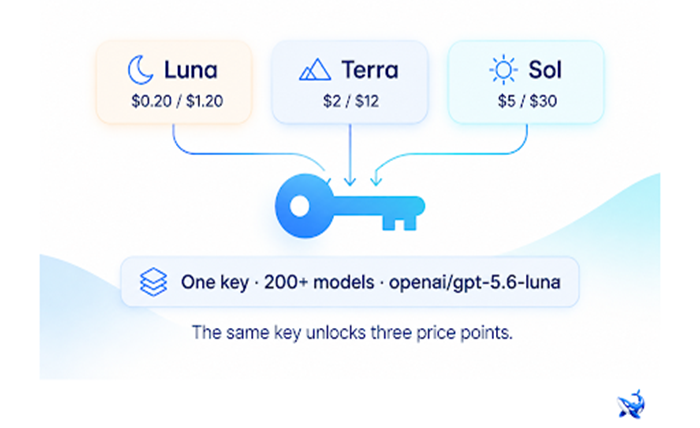
Here is where the “one key” part gets interesting. The GPT-5.6 family ships three tiers, and after OpenAI’s price cut they land at three very different price points, all reachable with the same credential:
| Tier | Input / output per 1M tokens (after the cut) | What it’s for |
| Luna | $0.20 / $1.20 (from $1 / $6 at launch, about 80% off) | economy, high-volume work |
| Terra | $2 / $12 (from $2.50 / $15, about 20% off) | the balanced default |
| Sol | $5 / $30 (unchanged) | flagship quality |
All figures are OrcaRouter’s reference pricing, the cut price passed through at 0% markup. One outside listing quotes Luna at $0.10 / $0.60 with a separate tier above 272k prompt tokens; our catalog and Artificial Analysis both read $0.20 / $1.20, so treat any published price as listing-dependent.
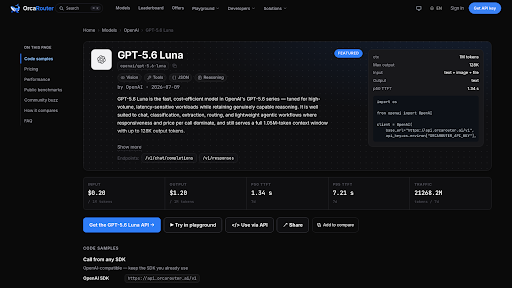
The tier you choose changes the bill far more than the effort setting does. Artificial Analysis’ live board puts Luna’s Intelligence Index at 52.32 in its max configuration, against a tier median of 17 — and at $0.05 per Index task, the cheapest on the board, versus $1.23 for Sol and $2.34 for Claude Opus 5. Its median output speed of 156.6 tokens/s sits among the fastest on the board, against 73.7 for Sol and 61.8 for Opus 5. On OrcaRouter’s own seven-day telemetry, Luna is the volume workhorse: p50 time-to-first-token of 1.33 seconds and 21,271.6M tokens in seven days, by far the highest traffic in the set. The “economy tier” label is doing real work — Replit’s Free Mode already runs on Luna.
Putting everything behind one key changes how you decide. You do not need to pre-commit to a tier: prototype on Luna, promote to Terra when a workload needs it, and escalate the genuinely hard one-off analyses to Sol — switching a model string, not issuing a new credential.
Why one key beats a key per vendor
The strongest argument for the router key is not GPT-5.6 Luna. It is that the same credential reaches every model in the catalog. Teams that integrate model-by-model, vendor-by-vendor, accumulate a wallet of keys, SDK wrappers and rate-limit dashboards — each one a moving part. A single key removes the orchestration tax: one base URL, one credential, and a model ID as the only thing that varies.
That structure also de-risks the model itself. GPT-5.6 Luna is weeks old. Automatic failover across providers covers the boring failure mode of a downed cluster, and the abstraction means that if Luna regresses or a workload turns out to need Terra, the change is a string in config rather than a deployment. You pay list price, you carry one key, and you keep your options open.
A practical key-management note for teams starting out: keep the key scoped and auditable from day one rather than shared on a whiteboard. Because a single unified key fronts 200-plus models, its blast radius is larger than a per-vendor key, so pair it with per-team budgets and role limits, and review the request logs before you review the invoice. The key is the front door; the governance around it is what keeps a $0.20 economy model from turning into an uncontrolled spend line.
The takeaway
The GPT-5.6 API key question is really two decisions. First, where the key lives: OpenAI’s platform key is fine when the family is all you call; a single router key earns its keep the moment you want more than one vendor on one credential, at 0% markup with automatic failover. Second, which tier sits behind it: prototype on Luna at $0.20 / $1.20, run interactive work on Terra, and save Sol’s $5 / $30 for the workloads that genuinely need flagship quality. The model ID is openai/gpt-5.6-luna, the surface is OpenAI-SDK-compatible, and the key hygiene rules are the same everywhere. Start with Luna, keep a fallback, and let the usage numbers tell you when to move up.